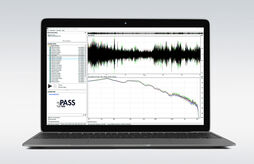
KEEPING CRITICAL COMMUNICATIONS CLEAR, CONNECTED AND MISSION-READY.
Communication systems must perform reliably even under demanding network, acoustic and environmental conditions. Latency, interoperability issues, or impaired speech intelligibility can affect the efficient exchange of information.
HEAD acoustics provides comprehensive and highly precise testing solutions for evaluating communication networks, terminals, headsets, and wearables. By combining network emulation, electroacoustic measurement, perceptual evaluation, and realistic background noise simulation, we bring real-world conditions into the laboratory.
Our solutions allow developers and integrators to test the performance of communication chains. This ensures a thorough and consistent evaluation of every aspect, including the network architecture, the connected terminals, and the speech signal received by the user.

Modern communication architectures combine different transmission paths, network technologies, and terminal types. Reliable operation requires more than basic connectivity: latency, interoperability, and end-to-end communication quality must be evaluated across the entire system.
HEAD acoustics test solutions enable the controlled and reproducible evaluation of Mesh-Over-Everything architectures. You can systematically examine different network conditions, transmission paths, and terminal configurations in the laboratory and in the real world.
Our solutions make it possible to measure end-to-end latency and assess interoperability between networks, interfaces, and terminals. They help developers evaluate connection stability and voice and audio quality across different transmission paths. Network impairments and changing connection conditions can be introduced in a controlled manner to investigate their influence on communication performance.
You can also analyze system behavior during handovers or changes between available transmission paths. This makes it possible to identify weak points early, compare system configurations, and validate communication performance under defined conditions.

Tests in real environments provide valuable insights, but environmental and network conditions are often difficult to control and reproduce. HEAD acoustics brings relevant real-world conditions into the laboratory, where they can be varied, repeated, and analyzed systematically.
Realistic test scenarios can include characteristic background noise, reverberation, acoustic reflections, and competing talkers. The positions of talkers and listeners can be varied, while reproducible head movements enable the evaluation of dynamic and direction-dependent system behavior.
At the same time, you can control network conditions such as delay, jitter, and packet loss. The same test scenario can incorporate changing transmission paths, different terminal configurations, and multiple communication interfaces.
Combining acoustic, electroacoustic, and network-related influences lets you evaluate the entire communication chain under consistent conditions. You can identify the causes of communication problems more precisely and verify improvements using directly comparable measurements.

Communication performance depends not only on the network. Headsets, microphones, hearing-protection systems, and wearable communication devices form the critical interface between users and the communication system.
HEAD acoustics provides automated and reproducible testing solutions for professional communication headsets, in-ear and over-ear devices, wearable communication systems, and handheld or hands-free terminals. The portfolio also supports the evaluation of devices incorporating bone-conduction microphones, active noise cancellation, hear-through or talk-through functionality. By testing terminals and networks together, developers can evaluate the complete communication chain rather than isolated components.
Tests can cover sending and receiving performance, speech intelligibility, speech quality, frequency response, distortion, noise attenuation, echo behavior, and other relevant electroacoustic parameters.
Speech intelligibility indicates whether listeners can understand spoken information correctly. Speech quality additionally considers how natural, clear, and undisturbed listeners perceive the transmitted voice. Listening effort describes how much concentration a listener needs to follow speech under difficult acoustic or transmission conditions. Evaluating these aspects provides a more complete understanding of the actual communication performance.

Bone-conduction sensors can help communication devices distinguish the wearer’s voice from surrounding noise. To evaluate these systems realistically, airborne and structure-borne speech components must be reproduced in a controlled and synchronized manner.
HEAD acoustics’ ViBRIDGE technology enables holistic testing of in-ear devices and headsets equipped with bone-conduction sensors. In combination with realistic noise simulation, developers can investigate how reliably a device captures and transmits speech under demanding acoustic conditions. You can also systematically evaluate active noise cancellation, passive noise attenuation, and talk-through functions, including examining how effectively background noise is reduced and whether relevant external sound remains audible.
The results provide a reliable basis for developing and optimizing voice pick-up algorithms, speech enhancement, noise reduction, and echo cancellation. They also help developers assess interactions among active noise cancellation, passive attenuation, ear-through functionality, and other signal-processing components.
In addition to the technical performance of individual algorithms, you can evaluate speech intelligibility, speech quality, and listening effort. This helps determine not only whether a transmitted message can be understood, but also how clearly, naturally, and effortlessly it can be perceived.

Wearable and spatial communication systems increasingly respond to the position and movement of the user’s head. Delays between the physical head movement and the corresponding audio signal adaptation can affect orientation, speech intelligibility, and the overall user experience.
With reproducible, motorized head movements, HEAD acoustics enables the evaluation of head motion-to-signal latency and direction-dependent system behavior. This allows developers to investigate how head-tracked audio systems, adaptive beamforming, and spatial audio rendering respond to defined movements.
You can also evaluate direction-dependent microphone performance and dynamic hear-through functions. By varying the positions of talkers and listeners, developers can analyze how reliably a system adapts to changing acoustic situations.
Repeatable movement patterns make different devices, algorithms, and system configurations directly comparable. They also provide a consistent basis for identifying latency and evaluating the effectiveness of system improvements.
COMPREHENSIVE SOLUTIONS FOR RELIABLE COMMUNICATION
HEAD acoustics combines measurement hardware, analysis software, acoustic simulation, and engineering expertise to test and validate communication systems.


Evaluate latency, interoperability, transmission quality, and reliability across heterogeneous and mesh-based network architectures. You can examine different connections, interfaces, and transmission paths individually or as part of a complete end-to-end system.

Test sending and receiving performance, as well as speech intelligibility, speech quality, and listening effort. Evaluate noise attenuation, active noise cancellation, and talk-through functionality under reproducible acoustic conditions.

Evaluate devices that use structure-borne speech signals, in-ear sensors, or body-worn microphones. Airborne and structure-borne speech components can be combined with realistic background noise to assess device performance under defined conditions.

Assess handheld, hands-free, and integrated terminals as part of the complete communication chain. Evaluate electroacoustic device performance alongside the influence of networks, interfaces, and transmission conditions.

Relevant Products and Solutions


HMS II.3
(HMS II.3,HMS 2.3,HMS II,HMS 2,HMS,artificial head,head,binaural,1703,1750,1574,1357,1967)