
Psychoacoustics
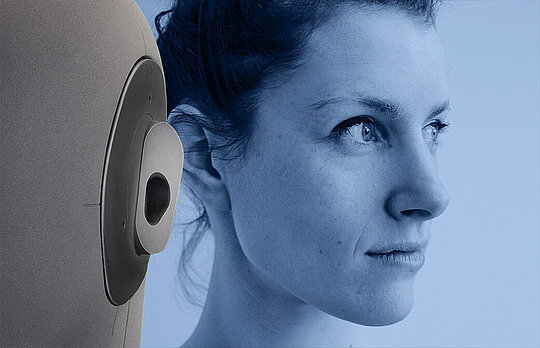
Focusing on the listening experience
Psychoacoustics explains scientifically how we perceive sounds - and this goes far beyond pure sound pressure.
Psychoacoustic analyses give manufacturers real competitive advantages when they optimize the sound quality of their products.
The challenge lies in numerically modeling sound perception and thus making it visible - for reliable evaluation.
Psychoacoustic phenomena and standards
- Loudness: describes how loud a sound event is subjectively perceived to be, regardless of the physical sound pressure level.
ISO 532-1, ISO 532-3, DIN 45631/A1, ANSI S3.4-2007, ECMA 418-2 - Tonality: tonal components of a sound determine whether it is perceived as clear (like a flute) or rustling (like leaves in the wind).
DIN 45681, ISO/ TS 20065, ECMA 418-1, ECMA 418-2 - Sharpness: describes how high frequencies make the sound shrill: more components sound sharper (like a circular saw), fewer sound less shrill (like the hum of an engine).
DIN 45692 - Roughness: describes how “scratchy” or “vibrating” a sound is perceived when it fluctuates very rapidly—like the humming of a chainsaw or electric razor.
DIN 38455, ECMA 418-2 - Fluctuation strength: describes how strongly the loudness of a sound rises and falls - as with a siren, for example.
ECMA 418-2
Exclusive Whitepaper: Understanding and Applying Specific Sharpness

Accurate assessment of psychoacoustic parameters, such as clarity, requires advanced signal processing and auditory modeling. Download our exclusive whitepaper now for free: our expert presents concrete examples illustrating how specific analysis of clarity facilitates sound evaluation and design across various application areas.
HEAD acoustics: Setting the standard in psychoacoustics
Our hearing model simulates the signal processing of the human auditory system. It explains and describes in detail psychoacoustic effects and basic auditory impressions.
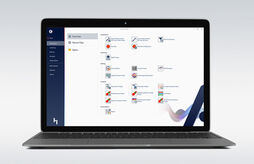
In addition to calculating standardized psychoacoustic variables such as loudness or sharpness, our products offer a range of more in-depth analysis features and functions. Analyze time and frequency patterns using, for example, the Relative Approach or tonal components with the tonality analysis.
Put the focus on perception!
Relevant Products
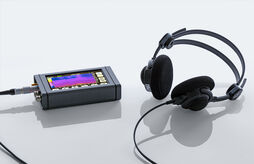
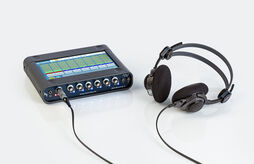
SQuadriga III
(SQuadriga III,SQuadriga 3,SQuadriga,3324,9850,3322)

